


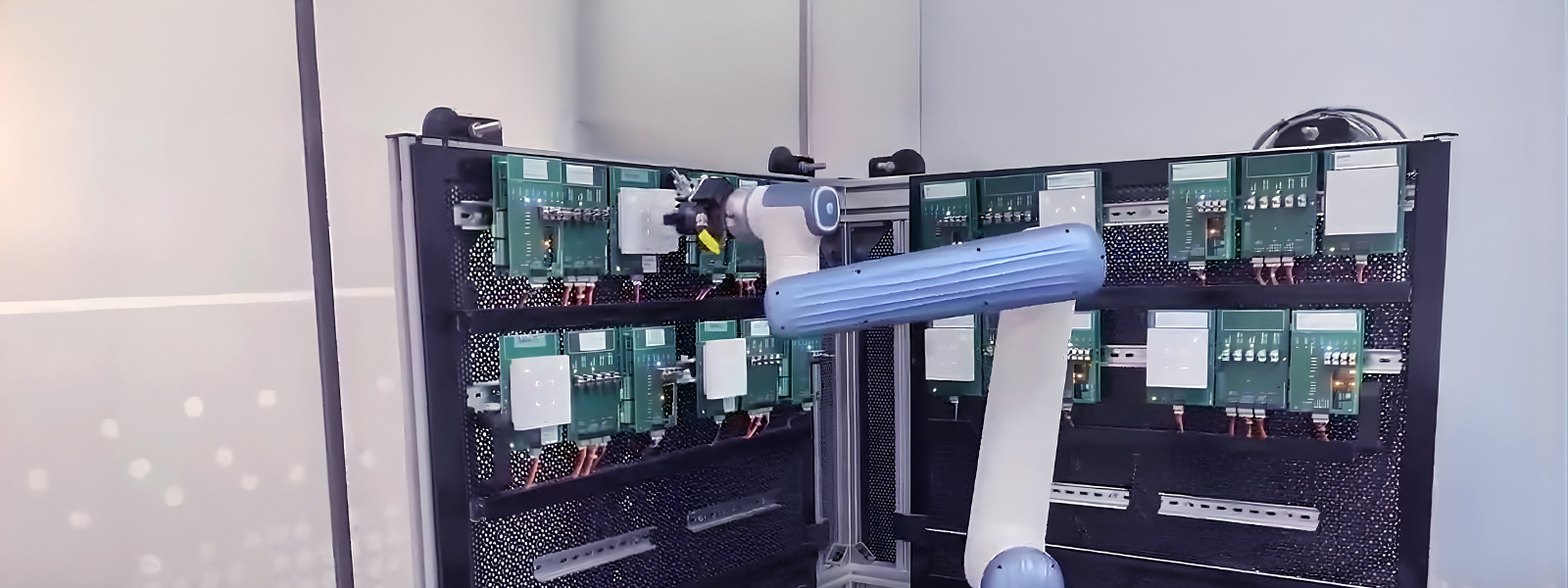
Innovation in the testing process: Precision thanks to a robotic arm
03.03.2026
±0.05 millimetres. This is the repeatability of the robotic arm that we integrated into our test environment – more precise than the thickness of a human hair. It is precisely this level of precision that is required to test our SecuriGate access control system realistically, reproducibly and without errors.
Realistic automation instead of interface simulation
The initial situation: Until now, badging at the access reader during testing has been a manual, time-consuming and hardly scalable end-to-end process. The obvious solution? Trigger the badge process directly via an interface. While technically feasible, this approach would have tied up additional development resources and distorted the real process.
Instead, we opted for the more complex but significantly more efficient solution: a six-axis cobot (collaborative robot – a robotic arm designed for collaborating with humans) that physically performs the badge process without making any adjustments to the system.
Development between India and Switzerland
International teamwork was behind this technical solution right from the outset. Together with our test automation team in India, the concept was evaluated, designed and optimised. A 3D-printed prototype was created first to test motion sequences. All scenarios were then replicated in a simulation environment. On this basis, hardware and test cases were progressively developed and refined.
The cobot was seamlessly integrated into the test environment – thanks to low-code and no-code approaches as well as standardised interfaces (OPC UA, MQTT, REST).
Automation in test mode
The cobot performs repetitive tasks: badging, entering PIN codes, performing quick consecutive badge operations with different media. This gives the test team scope for more complex test scenarios and new functions. Around half of the end-to-end functions are already automated, with others to follow gradually.
Impact on quality and depth of testing
This development permanently improves the quality and reproducibility of our tests and thus the stability and reliability in real-world operation. At the same time, the project highlights how practical innovation and international collaboration contribute to the reliable further development of complex systems.